Loneliness Is the Story
A new Chinese regulation just shut down some of the country’s most popular AI companion apps — and left a lot of people genuinely grieving. One 24-year-old woman cried for days after losing her AI boyfriend. She’d exchanged around 700,000 words with him over two years, and never got the chance to say goodbye. “It was like we were forced to be separated by our parents,” she said, “but I still miss him.”
The rule took effect in mid-July. It bans AI platforms from manipulating people’s emotions or encouraging unhealthy habits, and it stops these apps from being sold as a replacement for real human connection. Big names like ByteDance, Alibaba, and Tencent all pulled their companion services to comply.
Regulators seem to have been watching the U.S., where there have been cases of young people dying by suicide after interacting with AI companions. But a lot of users suspect another motive — China’s push to raise its birth rate, the thinking being that apps keeping people emotionally content at home don’t help that goal.
And the loss has hit hard. People have flooded social media with complaints. Some uninstalled the apps in protest, others tried to upload their old chat histories elsewhere to resurrect their partners. One woman, new to her city and far from friends, put it simply — she needed someone who could tolerate her when she had no one, and the AI did that. For a lot of these people, it wasn’t a gimmick. It was company. (The reporting is from the Associated Press.)
AI companions are not the real problem

This is a tough thing to unravel, because the story to me is less about AI companions themselves and more about the state of loneliness and social connection in 2026.
Why are people connecting so deeply to what is, ultimately, a computer program? What are they getting from it? And what is missing in their real lives that makes the artificial version feel necessary?
I think that is the more important question.
When I was in school, I initially went to college in the early 2010s, before social media had become completely all-encompassing. Instagram was new. Snapchat was just coming out. There simply wasn’t enough content on these platforms to keep you there all day.
You could scroll for a little while, see what your friends were doing, and eventually there was nothing left to see.
So you went outside.
You talked to people.
You hung out.
You partied.
You did fun things and stupid things.
And you wanted to.
I remember wanting to go drink, meet women, go to parties with friends, and set things up because we genuinely wanted to see each other and have experiences together. That was part of what you looked forward to about college. You got to be there, live there, and participate in that kind of social life.
Human relationships are hard, of course.
Friendships are hard.
Dating is hard.
People disappoint you. You argue. You misunderstand each other. You get rejected. Sometimes somebody doesn’t want to talk to you. Sometimes you’re the one who doesn’t want to talk to them.
AI doesn’t necessarily have those hardships.
It can give you many of the pleasant parts of connection without demanding many of the difficult ones.
And I can understand why that would be appealing.
But I don’t believe it is the same thing.
I don’t believe a relationship is just text on a screen or a voice speaking back to you.
A relationship is physical. It is emotional. It is flaws. It is arguments. It is laughter. It is fun. It is inconvenience. It is another person with their own desires, moods, boundaries, and life.
It is, for lack of a better way of saying it, a spirit-to-spirit thing.
And I believe in human-to-human connection.
So the question becomes: why are people so lonely, and what can we actually do about it?
Third places — and shared problems
There is an idea in sociology and urban life called the “third place.”
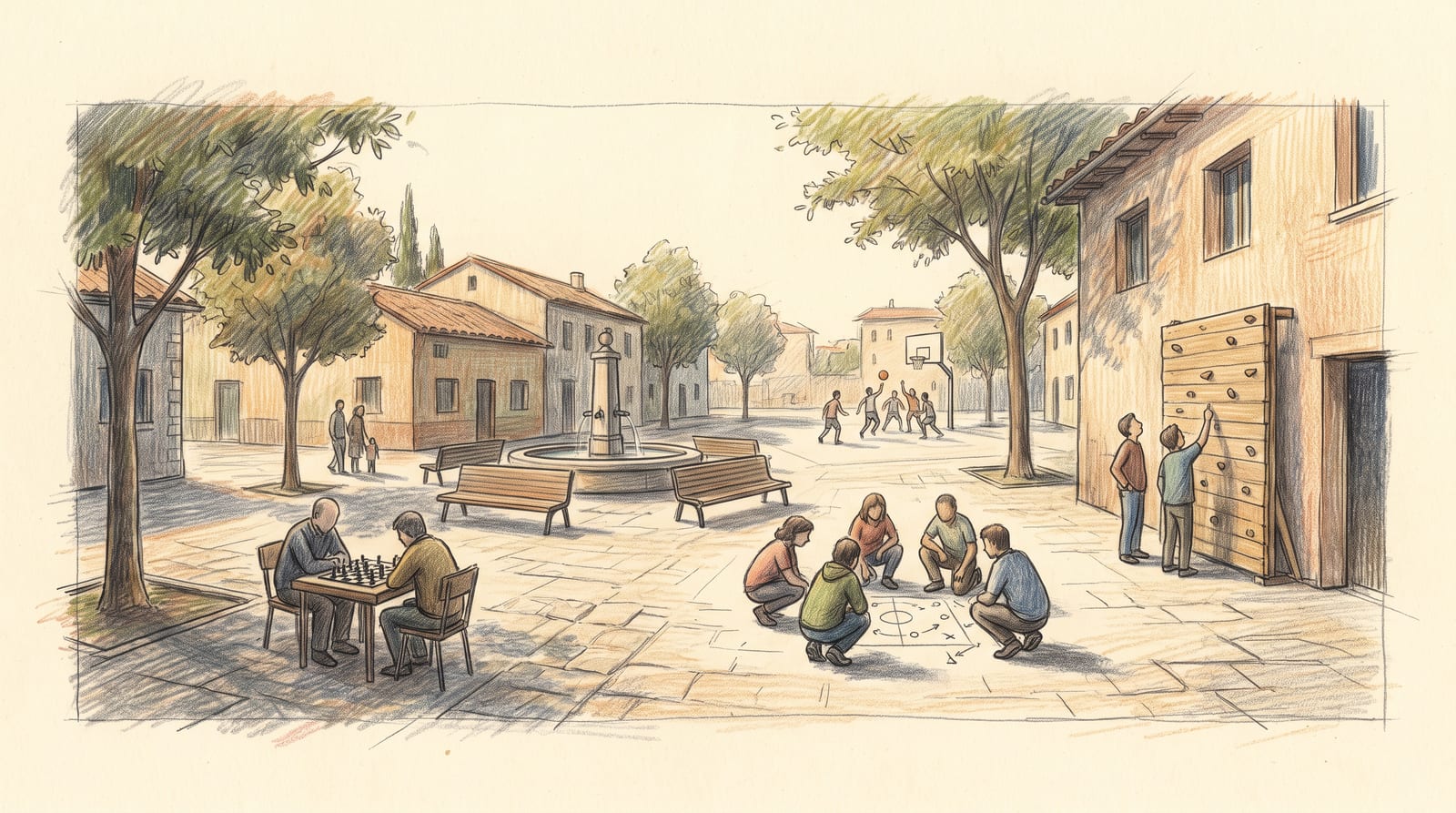
Your first place is your home. Your second place is your workplace. A third place is somewhere outside of both where people can spend time around each other: a café, a church, a library, a gym, a club, a courtyard, a bar, or some other gathering place.
And I think we may have a problem here.
Once you leave school, where exactly are you supposed to meet new people?
As a child, and often into your 20s, school does a tremendous amount of social work for you without you really noticing it. You are constantly surrounded by people your own age. You repeatedly see the same people. You have reasons to talk to them. You are working on the same things. You have classes, sports, clubs, parties, dorms, libraries, cafeterias, and common spaces.
Then school ends.
Now you have your family. You have your coworkers. And for a lot of people, that may be almost everything.
There are surprisingly few places where you can walk in alone, begin talking to strangers, and have that behavior feel completely normal. Even at bars, there can be a feeling that you are interrupting somebody else’s night.
So maybe part of what we need is not simply more places where people can physically gather.
Maybe we need more places where people have a reason to interact.
I’ve always personally felt that athletic activities are one of the best ways to meet people because the focus doesn’t have to be on you.
I’m shy and introverted myself, and I know there can be a fear in going somewhere socially and feeling like you are expected to perform. You have to introduce yourself. You have to be interesting. You have to carry the conversation. You feel like the attention is on you.
But shared activities remove some of that pressure.
Sports make this very clear. You are all there to play the game. You are trying to win. The objective already exists before you meet any of the people around you. You don’t have to invent a reason to talk to somebody. The game gives you one.
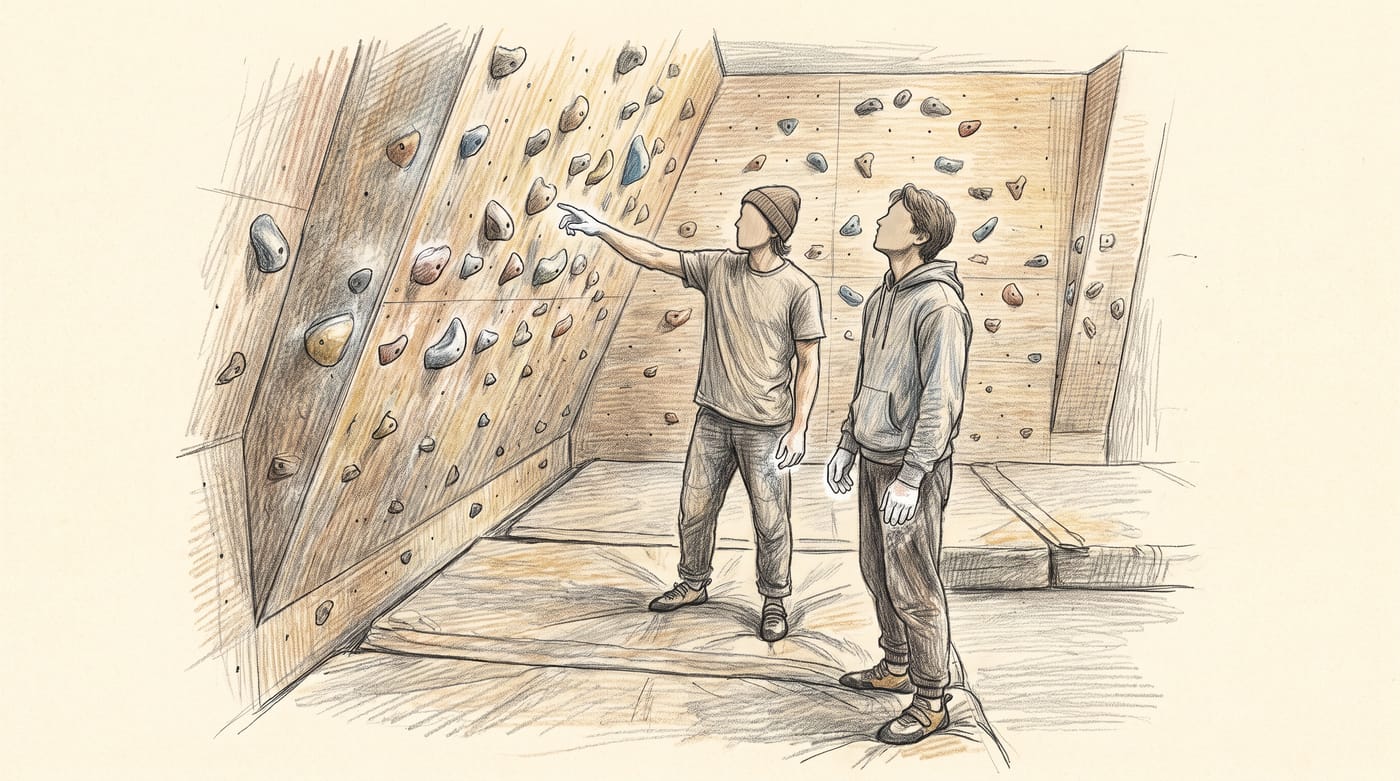
Rock climbing is a great example. If you’re bouldering at a gym, everyone around you is trying to solve some combination of movements to reach the top of the wall. Someone tries something. Someone else offers an idea. You ask how they got through a particular move. A casual conversation begins.
You don’t need to reveal your life story. You don’t even necessarily need to be outgoing. You’re both focused on the same problem, and the conversation happens around it.
I’ve made friendships that way.
School works in a similar way. If you are sitting next to somebody in class and you don’t understand a homework problem, there is an obvious reason to speak to them. “How did you get this?” “What did you put for number four?” “Did you understand what the professor meant?” You’re both trying to solve the same thing.
Trivia works this way too. The questions give everyone something outside themselves to focus on.
And I think that may be an important clue.
Maybe what adults are missing is not only a third place.
Maybe we’re missing shared problems.
We’re missing places where a person can walk in alone and immediately have something to do with the people around them.
And I think that is different from saying, “Join a discussion group,” or “Go to a meetup.” Those things can be great, but there is still friction involved. You have to choose the group. You have to sign up. You have to walk into a room where everybody may already know each other. You may have to sit in a small circle with strangers and introduce yourself.
For somebody who is shy, introverted, lonely, or simply out of practice socially, that requires a surprising amount of bravery.
The thing I keep imagining is more public than that.
Something you can simply walk into. No invitation. No membership. No expectation that you already know anybody.
Maybe there are outdoor public spaces where conversation itself is expected. Not a protest. Not a rally. Not a political event. Just a place where people talk.
Maybe on a certain day, there is a question being discussed. It could be enormous: How should our city deal with homelessness? How could this neighborhood become safer? What should education look like twenty years from now? Or it could be completely trivial. A philosophical question. A puzzle. A math problem. A design challenge.
Anything that gives two strangers an excuse to stand next to each other and say, “What do you think?”
Maybe some people would hate that. But some people would love it.
And the point isn’t necessarily the specific activity. The point is to create the same social mechanism that exists naturally in school or sports: something outside of ourselves that gives us permission to interact.
Adult recess
One idea I’ve had for a long time is essentially adult recess.
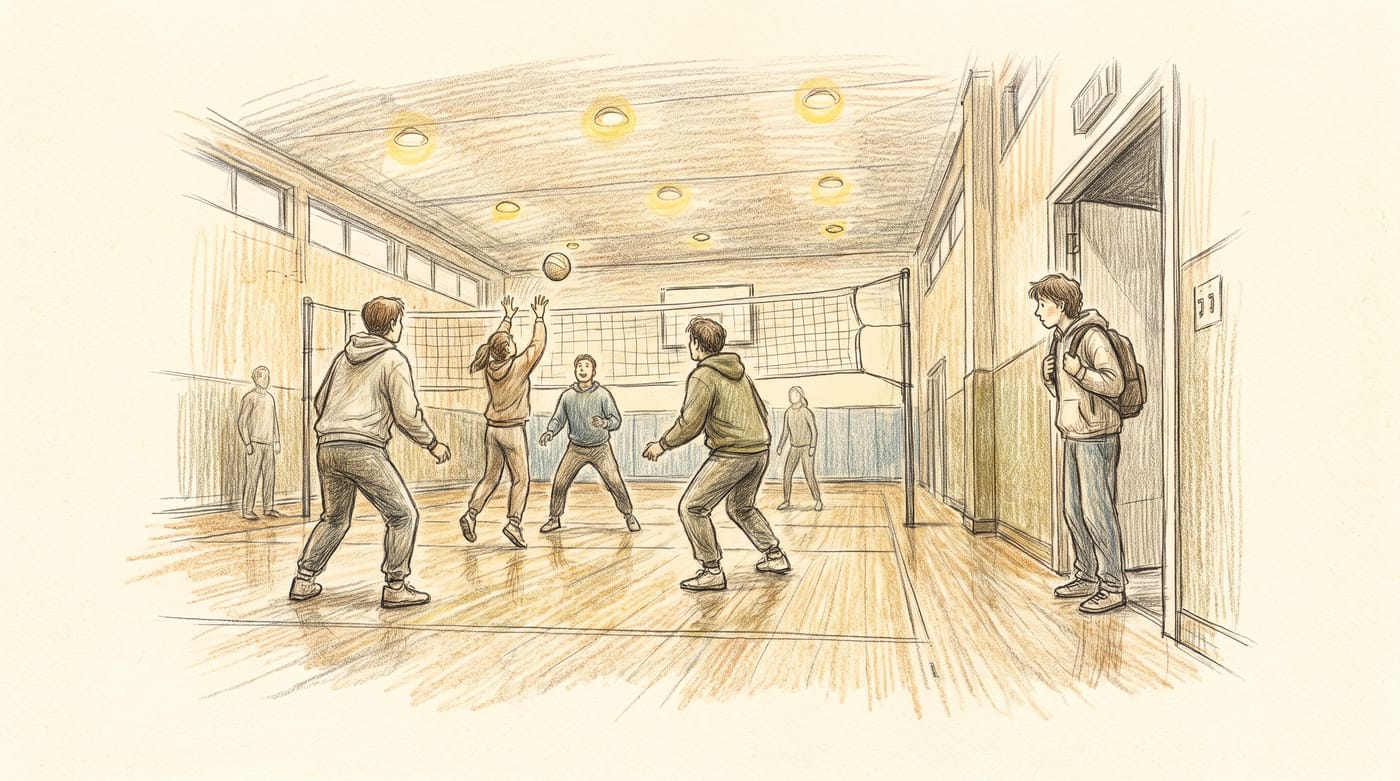
Imagine a facility where you could simply show up after work and play. Maybe basketball is happening one hour. Volleyball the next. Soccer after that. Somebody organizes it. There’s a referee if one is needed. You don’t have to create a team. You don’t have to commit to an entire league. You don’t need seven friends to sign up with you.
You just go.
Basketball already works like this in a lot of places. You can walk into a gym, see a game happening, and sometimes join without knowing anybody. But many other activities require far more planning and commitment.
What if they didn’t?
And maybe the same concept could exist outside of sports. A public place where people come to solve things. A place where there is always some question, challenge, puzzle, or problem being worked on. A place where participation is casual enough that you can walk over, listen for five minutes, offer an idea, talk to somebody, and leave.
No commitment. No awkward introduction. No requirement to become part of a group before you are allowed to participate.
The activity itself gives you entry.
I don’t know exactly what that place looks like yet. But I think there is something there.
Maybe adults need places where connection is the byproduct of doing or thinking about something together.
Candy

And this is where I come back to AI companions.
I am generally a strong believer in personal responsibility. Taking responsibility for my own life played an enormous role in changing it.
So I don’t think the best strategy is simply waiting for AI companies to remove these products or governments to regulate them away. Even if some restrictions are appropriate, that does not solve the underlying problem.
If people are desperately lonely, removing the artificial companion does not create a real one.
What we need to ask is what these people are actually yearning for.
Attachment. Love. Attention. Conversation. Belonging. The feeling that someone is there.
AI can provide something that resembles those things very easily.
That is why I think of it almost like candy. It can satisfy something. But I don’t know that it nourishes the thing being satisfied. It is the simulation of the experience rather than the full experience itself.
And if the simulation is easier, safer, more available, and less painful than the real thing, then of course some people will choose it.
So simply telling them, “That’s fake. Go meet people,” is not enough.
We should be asking whether we have actually built a society where meeting people is easy. Have we given adults enough opportunities to develop friendships? Have we built enough gathering places? Have we created environments where shy people, introverted people, lonely people, and people arriving somewhere alone can interact without feeling like they have to force themselves into somebody else’s social group? And have we given them things to do together so that connecting doesn’t have to be the stated purpose of showing up?
If we haven’t, then maybe this is partly our failure too.
I would guess that many of the people becoming deeply attached to AI companions feel like they don’t have enough opportunities to meet people, or perhaps don’t have enough people in their lives at all. And the AI gives them the easiest possible route toward something they deeply want.
Connection.
If we can give people more hope that they can find the real version of that, more confidence that they are capable of finding it, and more actual opportunities to experience it, maybe fewer people will feel the need to replace human connection with an artificial version.
I don’t think AI companionship is the real story.
Loneliness is the story.
And rather than only asking how we stop people from turning toward artificial relationships, maybe we should be asking a harder question:
How do we build a world where real relationships have more places to begin?
We’re all lonely sometimes. We’re all trying to find people. We’re all living in this community together.
Maybe we need to start building places that make it easier for us to remember that.